Monday, November 21, 2016

Principle of Prophetic Inerrancy (Part 1)

Image result for masjid al aqsa
In the Name of Allah; the Entirely Merciful, the Especially Merciful

Salutations of peace and blessings upon our beloved Prophet Muhammad, and upon his family, companions, and progeny.

In this entry, I will elucidate a very important principle of Islam regarding the authority and infallibility of the Prophet (peace be upon him).

Before we discuss the principle of Prophetic inerrancy the respected reader should understand that the ultimate authority in Islam is the Word of Allah, the Holy Qur’an. That is the Book of God, the literal speech of Allah Most High. It’s every letter, jot, and particle is Wahi (divine revelation).
As such, for a believing Muslim, the Holy Qur’an is unquestionable and inerrant. This is not to say that Muslims may legitimately disagree over the correct interpretation of Qur’anic Verses, but that it is essential and required for a Muslim to sincerely acknowledge that the Book of Allah is the supreme authority on the basis of it being Allah’s spoken Words that have reached us through revelation.

Consequently, it is a firm principle in Islam that the Prophet Muhammad (peace be upon him), to whom the Qur’an was revealed, was perfect and infallible in his conveying of God’s revelation to us in the capacity of being a Prophet.

Secondly, the Prophet (peace be upon him) did not receive only the Holy Qur’an as divine revelation, but received other inspirations which constitute the basis for the Sunnah, the second most important authority in Islam. The Sunnah is the way or path of the Prophet (peace be upon him) in practically following Islam, for example, the precise method of offering different acts of worship, and guidance for all Muslims on how to live their lives. The Sunnah is based on Ilhaam (divine inspiration), but unlike the Qur’an, it is not a book or text. Rather, the Sunnah are traditions and customs that have been passed down from generation to generation by Tawaatur. These are the two fundamental sources and authorities in Islam whose authenticity, due to Tawaatur, cannot be rationally impugned.

The third source is the Hadith. The Hadith corpus are narrations and reports that are traced back to the Prophet (peace be upon him) through Isnaad (chains of narrators). Muslims must approach the Hadith with more skepticism and caution because they are not always authentic. The Muhadditheen (scholars and experts of Hadith) were incredible individuals who expended utmost effort to determine the authenticity of each and every individual Hadith, by examining the narrators and other factors. Nevertheless, the Muhadditheen were not infallible and it is not only possible but a certainty that they were not always correct but that they erred. The Hadith contain the sayings, actions, and approvals of the Prophet (peace be upon him) which constitute an important source for our religious guidance. However, the methodology of the real Ahlus Sunnah (the orthodox sect of Muslims) is to give preference to the Qur’an and mass-transmitted Sunnah over and above solitary reports of Hadith. But if a Hadith does not contravene any verse of the Qur’an or any aspect of the mass-transmitted Sunnah (and the majority of Hadith do not contravene), then there is no harm in accepting and acting upon such Hadith, provided that the individual Hadith is not too suspect in its authenticity (Da’eef) or fabricated (Mawdoo’).

However, in this entry I would like to touch upon an important principle with relates to acceptance of even those Hadith which are Saheeh (authentic). As Muslims, we believe that the Prophet (peace be upon him) was in communion with Allah and a recipient of divine revelation. Furthermore, he was protected by Allah with regard to conveying the Deen to us. However, being a human being, he also made statements which were not based on revelation or his being in the role of a Prophet, but some statements of his were based on his personal opinion. The following Hadith demonstrate this fact:
أَنَّ أُمَّهَا أُمَّ سَلَمَةَ رَضِيَ اللَّهُ عَنْهَا زَوْجَ النَّبِيِّ صَلَّى اللَّهُ عَلَيْهِ وَسَلَّمَ أَخْبَرَتْهَا ، عَنْ رَسُولِ اللَّهِ صَلَّى اللَّهُ عَلَيْهِ وَسَلَّمَ ، أَنَّهُ سَمِعَ خُصُومَةً بِبَابِ حُجْرَتِهِ فَخَرَجَ إِلَيْهِمْ ، فَقَالَ : " إِنَّمَا أَنَا بَشَرٌ ، وَإِنَّهُ يَأْتِينِي الْخَصْمُ ، فَلَعَلَّ بَعْضَكُمْ أَنْ يَكُونَ أَبْلَغَ مِنْ بَعْضٍ ، فَأَحْسِبُ أَنَّهُ صَدَقَ ، فَأَقْضِيَ لَهُ بِذَلِكَ ، فَمَنْ قَضَيْتُ لَهُ بِحَقِّ مُسْلِمٍ ، فَإِنَّمَا هِيَ قِطْعَةٌ مِنَ النَّارِ فَلْيَأْخُذْهَا أَوْ فَلْيَتْرُكْهَا "

Narrated Umm Salama, wife of the Prophet (Sallallahu ‘alayhi wasallam) from Allah’s Apostle (Sallallahu ‘alayhi wasallam) that he heard some people quarreling at the door of his dwelling. He came out and said, “I am only a human being, and opponents come to me (to settle their problems); maybe someone amongst you can present his case more eloquently than the other, whereby I may consider him true and give a verdict in his favor. So, if I give the right of a Muslim to another by mistake, then it is really a portion of (Hell) Fire, he has the option to take or give up (before the Day of Resurrection).”
(Sahih al-Bukhari)
This Hadith indicates that the Prophet (peace be upon him) did not always make decisions on the basis of Wahi (divine revelation), and did not always make statements in the role of being a Prophet. Rather, being the leader of influence in his community, people came to him to settle their disputes and seek counsel. No doubt, the Prophet (peace be upon him) was qualified to do so, as he undertook this role even before his proclamation of the Nubuwwah (prophethood). However, the Prophet (peace be upon him) himself stated that being a human being it is not necessary that each and every one of his decisions is infallible. Only those decisions, commands and statements of his which are based on Wahi are infallible and unquestionable.
حَدَّثَنِي رَافِعُ بْنُ خَدِيجٍ ، قَالَ : " قَدِمَ نَبِيُّ اللَّهِ صَلَّى اللَّهُ عَلَيْهِ وَسَلَّمَ الْمَدِينَةَ ، وَهُمْ يَأْبُرُونَ النَّخْلَ ، يَقُولُونَ يُلَقِّحُونَ النَّخْلَ ، فَقَالَ : مَا تَصْنَعُونَ ؟ قَالُوا : كُنَّا نَصْنَعُهُ ، قَالَ : لَعَلَّكُمْ لَوْ لَمْ تَفْعَلُوا كَانَ خَيْرًا ، فَتَرَكُوهُ ، فَنَفَضَتْ أَوْ فَنَقَصَتْ ، قَالَ : فَذَكَرُوا ذَلِكَ لَهُ ، فَقَالَ : إِنَّمَا أَنَا بَشَرٌ ، إِذَا أَمَرْتُكُمْ بِشَيْءٍ مِنْ دِينِكُمْ ، فَخُذُوا بِهِ ، وَإِذَا أَمَرْتُكُمْ بِشَيْءٍ مِنْ رَأْيٍ ، فَإِنَّمَا أَنَا بَشَرٌ "

Rafi' b. Khadij reported that Allaah's Messenger (sallAllaahu alayhi wa sallam) came to Medina and the people had been grafting the trees. He said: What are you doing? They said: We are grafting them, whereupon he said: It may perhaps be good for you if you do not do that, so they abandoned this practice (and the date-palms) began to yield less fruit. They made a mention of it (to the Prophet), whereupon he said: I am a human being, so when I command you about a thing pertaining to religion, do accept it, and when I command you about a thing out of my personal opinion, keep it in mind that I am a human being.
(Sahih Muslim)

Here again we see that the Prophet (peace be upon him) makes a distinction between following him as it pertains to the Deen (religion), and following him as it pertains to his personal opinion in matters that are unrelated to the Deen. We have to remember that the Prophet’s authority in the Deen is not derived from his essence, but from Allah. Being a Messenger, he is chosen by Allah to simply convey to us, in his sayings and actions, the Religion of Islam including its laws and regulations, or the Shari’ah. In this capacity and role of being a Prophet, he is divinely protected from error and is infallible. However, in matters that are not Shar’an (relating to the Shari’ah), the Prophet (peace be upon him) may have given his personal opinion and it is not necessary that his personal opinion in such matters is always correct:
عَنْ أَنَسٍ ، " أَنّ النَّبِيَّ صَلَّى اللَّهُ عَلَيْهِ وَسَلَّمَ ، مَرَّ بِقَوْمٍ يُلَقِّحُونَ ، فَقَالَ : لَوْ لَمْ تَفْعَلُوا لَصَلُحَ ، قَالَ : فَخَرَجَ شِيصًا ، فَمَرَّ بِهِمْ ، فَقَالَ : مَا لِنَخْلِكُمْ ، قَالُوا : قُلْتَ كَذَا وَكَذَا ، قَالَ : أَنْتُمْ أَعْلَمُ بِأَمْرِ دُنْيَاكُمْ "

Anas reported that Allaah's Messenger (sallAllaahu alayhi wa sallam) happened to pass by the people who had been busy in grafting the trees. Thereupon he said: If you were not to do it, it might be good for you. (So they abandoned this practice) and there was a decline in the yield. He (the Prophet) happened to pass by them (and said): What has gone wrong with your trees? They said: You said so and so. Thereupon he said: You have better knowledge (of a technical skill) in the affairs of the world.
(Sahih Muslim)

Here the Prophet (peace be upon him) is even clarifying that it is possible others have superior knowledge to him in certain worldly affairs, such as agriculture, dendrology, etc. For example, the famous episode that occurred during combat preparations for the Battle of the Trench (Khandaq). The Prophet’s wise and knowledgeable companion, Salman the Persian (Allah be pleased with him) asked the Prophet whether the strategy he had laid out in preparation for the battle was on the basis of Wahi (divine revelation) or Rayy (the Prophet Muhammad’s personal opinion), to which the Prophet (peace be upon him) answered that it was based on his personal opinion and assessment of the situation. Salman the Persian, after seeking this important clarification, then proceeded to recommend an alternative strategy of digging a trench around Medina, from which the battle acquired its name (Battle of the Trench).

Here is another example of how the Prophet’s (peace be upon him) personal opinion, recorded in an authentic Hadith of Bukhari Sharif, turned out to be incorrect because it a statement he expressed from his own personal observation and not on the basis of Wahi:

Narrated Abu Hurairah (Allah be pleased with him): The Prophet (Sallallahu ‘alayhi wasallam) said: “A group of Israelites were lost. Nobody knows what they did. But I do not see them except that they were cursed and transformed into mouses and rats, for if you put the milk of a she-camel in front of a mouse or rat, it will not drink it, but if the milk of a sheep is put in front of it, it will drink it.”
(Sahih al-Bukhari)

Here we can clearly see that the Prophet (peace be upon him) gave his personal opinion regarding a group of Israelites that were lost and never seen again. The Prophet (peace be upon him), based on his personal opinion and not Revelation, stated that they were cursed and transformed into mice. This was based on his personal observation of mice, when he noticed that they do not drink camel’s milk but do drink sheep’s milk. Alternatively, the Hadith may be understood as a parable, in which the Prophet (peace be upon him) is comparing the Jews to mice in that both avoid camel’s milk. Such parables where groups of human beings, due to their peculiar characteristics, are described with names of certain animals, is part of the Islamic narrative, and there exist such parables throughout the Qur’an and Hadith. I have briefly touched on this vast subject in one of my previous entries here.

In the Darussalam edition and English translation of Sahih al-Bukhari by Dr. Muhammad Muhsin Khan, it is stated in the footnotes to this Hadith: “Later on the Prophet (Sallallahu ‘alayhi wasallam) was informed through revelation about the fate of those Israelites: They were transformed into pigs and monkeys.”
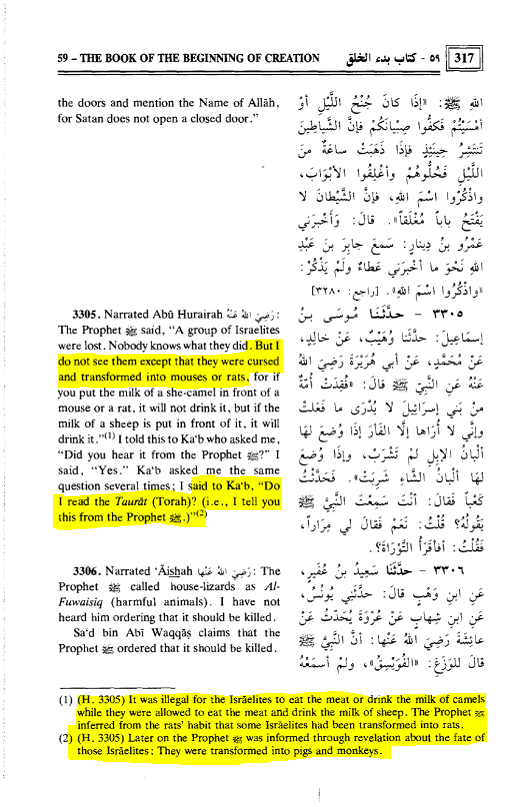
This is why it is so critical to have a more skeptical and nuanced approach to the Hadith, otherwise a person could mistakenly think that the Prophet’s personal opinion based on his own observation or experience is infallible and must be regarded as Deen, whereas that is simply not the case. The Prophet (peace be upon him) was, after all, a human being living in seventh century Arabia, and he himself confessed that it is possible that others may have more knowledge than him concerning worldly matters. This explains why many of the Prophet’s statements, which are based on his personal opinion, do not accord with modern scientific discoveries and facts. If a Muslim is not careful, he can end up embarrassing himself and other Muslims by blindly defending the veracity of such Hadith as proverbial Gospel truth by failing to understand the Islamic principle which makes a distinction between Wahi (divine revelation) and Rayy (Prophet’s personal opinion).

To be continued (In Sha Allah)

Sunday, November 20, 2016

Allah Created Adam and Wrote the Torah With the Touching of His Hand

In the Name of Allah; the Entirely Merciful, the Especially Merciful
There are two views concerning the establishment of Allah جَلَّ جَلَالَهُ over His ‘Arsh (Throne). According to ‘Abd Allah b. Sa’id b. Kullab (d. 240 H) and the Kullabiyya, Allah is established over His Throne without contiguity (Mummaassah). According to the Mujassimah (those who believe God is a corporal body), such as Muhammad b. Karram al-Sijistani, and the misguided Karramiyya sect, Allah is touching His Throne, or in contiguity (Mummaasah) with it.

Our view, however, is that both statements are speculative and should, therefore, not be professed. In other words, there is no evidence from the divinely-revealed texts of the Qur’an and Sunnah to either affirm or negate that Allah Most High is in contiguity with or physically touching His ‘Arsh.
Some of the latter scholars of the Salaf, such as Imam Abu Nasr al-Sijzi (d. 444 H), leaned toward the view that Allah is above His Throne but without contiguity/contact or touch. Imam al-Sijzi stated:

واعتقاد أهل الحق أن الله سبحانه فوق العرش بذاته من غير مماسة وأن الكرامية ومن تابعهم على قول المماسة ضلال

“The creed of the people of truth is that Allah, Holy is He, is above the Throne in His Essence without contiguity (Mummaasah), and the Karramiyyah and those who follow them are upon the misguided saying (affirming) contiguity (Mummaasah).”
Reference: Al-Radd ‘ala man Ankara al-Harf wal-Sawt; pp. 126 – 127


However, none of the early Salaf or scholars of Ahlus Sunnati wal Jama’ah seem to have either affirmed or negated Mummaasah with Allah for being over His Throne.
Now let the reader keep in mind that the attribute of Mummaasah is neither affirmed nor negated for Allah specifically in relation to the ‘Arsh (Throne). In fact, as indicated by the statement of Imam Abu Nasr al-Sijzi, negation of Mummaasah in relation to the ‘Arsh seems to be closer to the reality, but not because the attribute of Mummaasah is impossible or a defect for Allah.
On the contrary, the narrator Abu Saleh Maysarah al-Kufi (rahimahullah) says:

إِنَّ الله لَمْ يَمَسَّ شَيْئًا مِنْ خَلْقِهِ غَيْرَ ثَلَاثٍ: خَلَقَ آدَمَ بِيَدِهِ, وَكَتَبَ التَّوْرَاةَ بِيَدِهِ, وَغَرَسَ جَنَّةَ عَدْنٍ بِيَدِهِ

“Verily, Allah did not touch anything of His creation except for three: He create Adam with His Hand, wrote the Torah with His Hand, and planted Jannah (Paradise) of Eden with His Hand.”
Reference: Naqdh al-Darimi ‘alal-Marisi; no. 39


This is also reported from Ikrimah:
إِنَّ اللَّهَ عَزَّ وَجَلَّ لَمْ يَمَسَّ بِيَدِهِ شَيْئًا إِلا ثَلاثَةً : خَلَقَ آدَمَ بِيَدِهِ وَغَرَسَ الْجَنَّةَ بِيَدِهِ وَكَتَبَ التَّوْرَاةَ بِيَدِهِ
(Al-Sunnah of Abdullah b. Hanbal)
And from Khalid b. Ma’dan (d. 105 H):
إِنَّ اللَّهَ عَزَّ وَجَلَّ لَمْ يَمَسَّ بِيَدِهِ إِلا آدَمَ صَلَوَاتُ اللَّهِ عَلَيْهِ خَلَقَهِ بِيَدِهِ ، وَالْجَنَّةَ ، وَالتَّوْرَاةَ كَتَبَهَا بِيَدِهِ ، قَالَ : وَدَمْلَجَ اللَّهُ عَزَّ وَجَلَّ لُؤْلُؤَةً بِيَدِهِ فَغَرَسَ فِيهَا قَضِيبًا فَقَالَ امْتَدِّي حَتَّى أَرْضِي وَأخْرِجِي مَا فِيكِ بِإِذْنِي فَأَخْرَجَتِ الأَنْهَارَ وَالثِّمَارَ
(Ibid)


Hence, the attribute of Mass (contiguity or touching) is affirmed with Allah, but only for three specific things from His creation. We believe that Allah Most High wrote with His own Hand the Torah and gave it to Prophet Moses (peace be upon him).
Some people may object to this and ask how is it possible that the Dhaat (Essence) of Allah come into physical contact (Mummaasah) with something from His creation, such as touching the Torah, Adam, and Jannah with His Hand?

The answer to this objection is simply that we are not responsible for explaining “how”. Nor does such a belief necessitate either Tajsim or Tashbih. As long as a Muslim negates any general resemblance between Allah and His creation they are safe from the heresy of Tashbih (resembling Allah to His creation). So for example we believe that Allah touched the Torah with His Hand in that He wrote down the Torah with His Hand coming into contact with it, but we negate that this resembles a created human being writing something with their hand. And Allah knows best.

Iqbal's Book "Islam and Ahmadism" Refuted (Part 5)

In the Name of Allah; the Entirely Merciful, the Especially Merciful
Continuing on the theme of Finality of Prophethood, Iqbal mentions the views of Ibn Arabi (d. 1240):
“It is further claimed on the authority of the great Muslim mystic, Muhyuddin ibn Arabi of Spain, that it is possible for a Muslim saint to attain, in his spiritual evolution, to the kind of experience characteristic of prophetic consciousness.” (Islam and Ahmadism; p. 23)
In fact, not only Ibn Arabi, but many Sufis or Muslim “mystics” advocate this view. One may even argue that it is a view that is essential to Sufism. The reader should keep in mind that Sufism focuses on the experiential. The Sufi is the person who wants to experience a living relationship with God remnicient of the ancient Prophets. However, Iqbal argues that: “the Qadiani argument is based on a complete misunderstanding of his exact position. The Shaikh [Ibn Arabi] regards it as a purely private achievement which does not, and in the nature of things cannot, entitle such a saint to declare that all those who do not believe in him are outside the pale of Islam.” (p. 24)

We have already satisfactorily responded to Iqbal’s false straw-man argument here that the founder of the Ahmadiyya movement expelled from Islam any Muslim who does not believe in him. Rather, he stated: “I do not declare anyone who rejects my claim to be either a disbeliever or dajjal.” (Ruhani Khaza’in; v. 15, p. 432)
As for Iqbal’s assertion that Ibn Arabi regards the saint’s attainment of “prophetic consciousness” as a “purely private achievement”, the fact of the matter is that none of the great Sufis, mystics, and saints in Islamic history were isolationists who did not have a calling to share the fruits of their spirituality and gnosis with the rest of the Ummah. On the contrary, they were people active in preaching and teaching the public, taking disciples, gathering circles of followers around them, and travelling from place to place in the capacity of missionaries. Major Ulama (learned divines) of the Ummah did the same, but the difference is that the Ulama were recognized for their academic knowledge, especially in the fields of theology, jurisprudence, and law, whereas the Sufis attracted people to themselves through their piety, asceticism, miracles, and strong connection with God. This is not to say that the two categories are mutually exclusive. In orthodox Ahlus Sunnati wal Jama’ah, the two categories were in fact blended together, since the ideal Sufi or mystic is also a person of deep knowledge concerning the outer aspects of the Religion, such as law and jurisprudence, and the ideal ‘Alim (academic) is likewise a person of great piety, asceticism, and spirituality, and having deep knowledge of the inner aspects of the Religion, such as purification of the heart.
Furthermore, the orthodoxy, or Ahlus Sunnati wal-Jama’ah, hold the eschatological figures of the promised Imam or Mahdi, and Jesus during his second advent, to be men of the highest spiritual calibre within the Ummah. They are regarded as superior in terms of spiritual attainment and “prophetic consciousness” than any other Muslim saint or mystic. And it is a given that the figure of the Mahdi, for example, will not restrict his “prophetic consciousness” to being a “purely private achievement”. He will be a major public figure within the Ummah, indeed its very Imam (leader and guide), to whom the Ummah will, as a religious duty, owe him the oath of allegiance. Hence, Iqbal is again proven wrong when he states: “while it is psychologically possible for a saint to attain to prophetic experience, his experience will have no socio-political significance making him the centre of a new organisation” (p. 24). How does Iqbal explain the orthodox Muslim conception of the Mahdi and Messiah, who will undoubtedly, according to their conception, have a great “socio-political significance” as a direct result of their “prophetic experience” and not in spite of it.
Of course, Iqbal personally rejected the “Messianic” idea, and even says concerning the view of Ibn Arabi now under discussion: “I personally believe this view of Shaikh Muhyuddin ibn Arabi to be psychologically unsound” (pp. 23 – 24). Indeed, as we have previously mentioned, Iqbal was anything but an orthodox Muslim. He was a materialist, naturalist, and modernist. Nevertheless, the foundation of Iqbal’s argument against Ahmadism is that, being an alleged rejection of a core doctrine of Islam, it represents an internal threat to the solidarity and social cohesion of the Ummah. Yet we have proven and continue to prove that Ahmadism, at least as expressed in the writings and teachings of its founder Mirza Ghulam Ahmad, does not at all diverge from Islamic orthodoxy concerning any principle of Islam. The only real difference boils down to either an acceptance or rejection of Mirza Ghulam Ahmad as either a person truly attuned to God or not. The opposition that Ghulam Ahmad faced from the orthodox Ulama and Sufis, therefore, should be understood more as an opposition rooted in religious rivalry and not as opposition that is fundamentally doctrinal or theoretic. It is a common thing in the Sufi world for various orders and groups to oppose each other over personality, since personality reverence is a major aspect of Sufism. A Sufi or mystic making a grandiose claim concerning himself, such as that he is conversant with God, or that he receives inspiration through the Angels, or that he can produce extraordinary feats and miracles, may be attacked by his orthodox rivals not on the basis that such claims are tantamount to heresy, but on the basis that the claimant is a charlatan who seeks fame and glory for himself.

Saturday, November 19, 2016

Prophecy of the Cult of Dhu Khalasah

In the Name of Allah; the Entirely Merciful, the Especially Merciful

The Prophet Muhammad (peace be upon him) was undoubtedly a true prophet of God who made countless prophecies, multitudes of which have already been verifiably fulfilled.

The Prophet was sent to the pagan, idol-worshiping Arabs, who worshiped literally hundreds of idols and false “gods”. It is said that in the Sacred Ka’ba itself the pagan Arabs had placed 360 idols, one to worship for each day of the year.

But by the grace and divine help of Allah Most High, the Prophet Muhammad (peace be upon him) was successful in his mission, and put an end to idolatry in Arabia. Each and every idol-worshiping cult was terminated, the idols broken, and their temples and shrines razed to the ground.

One of the idols was Dhi al-Khalasah, a shrine in Yemen that was dedicated to the worship of a false god. The shrine rivaled the House of God in Mecca, and it was known as the Ka’bat al-Yamaniyah (the Yemenite “Ka’ba). The Prophet (peace be upon him) sent his companion Jarir b. Abdullah (Allah be pleased with him) with fifty knights from the noble tribe of Ahmas to destroy the idol. They ended up burning it to ashes, which greatly delighted the Prophet (peace be upon him) who invoked blessings of Allah upon them five times.

But amazingly, the Prophet (peace be upon him) predicted that one day the cult of Dhi al-Khalasa would be revived:

لَا تَقُومُ السَّاعَةُ حَتَّى تَضْطَرِبَ أَلَيَاتُ نِسَاءِ دَوْسٍ عَلَى ذِي الْخَلَصَةِ
“The Hour will not be established until the buttocks of the women of Daws (a tribe) move while going round Dhi al-Khalasa.”
(Sahih al-Bukhari; Kitab al-Fitan)
It is quite noteworthy that of the literally hundreds of idols that the pagan Arabs worshiped, the Prophet (peace be upon him) specified the cult of Dhi al-Khalasa as being revived before the Hour (Judgment Day).
Now the reader should be informed that this prophecy of the Prophet Muhammad (peace be upon him) has already been fulfilled. But instead of bringing testimony or evidence from an Islamic or Muslim source, I will quote a Lebanese Christian historian, Professor Kamal S. Salibi (1929 - 2011), professor of history at the American University of Beirut, to confirm this fact.
It is obvious that a Christian has no motive to fabricate history in order to prove the truth of a Prophet he does not believe in. Furthermore, it is highly doubtful that Prof. Salibi was even aware that the Prophet Muhammad (peace be upon him) had made this prophecy concerning the revival of the cult of Dhi al-Khalasa.
Nevertheless, Prof. Salibi writes:
“In the early seventh century, the worship of Dhu Khulasah was still popular in some Arabian regions; its principal sanctuary was somewhere south of Mecca – the famous al-Ka’bah al-Yamaniyah (the ‘Southern Kaaba’), rivalling that of Mecca, and believed to have been located in Tubalah, in inland Asir. After the triumph of Islam, Muhammad, we are told, sent a party of his followers to destroy the idol of Dhu Khulasah which stood there – a sculpture of white stone depicting a phallus topped by a crown. The cult of Dhu Khulasah, however, was subsequently resurrected in the region, where it survived until 1815. In that year, the Wahhabis organized a special military campaign to suppress remnants of pagan worship in different parts of Asir, and the reconstructed idol of Dhu Khulasah in his original Kaaba of Tubalah was destroyed by gunfire.”


Reference: Who was Jesus? Conspiracy in Jerusalem; p. 146


Furthermore, the prophecy indicates that the women of the Daws tribe in particular will be in the forefront of the worship of this false god Dhi al-Khalasa. This fact is confirmed by another non-Islamic source, Mark A. Caudill writes:
“Another temple dedicated to the phallus god Dhu al-Khalasah (‘he who has substance’, represented by a carved piece of white quartzite) is said to have existed at a place called al-Waliyyah (near the present-day northern Asir town of Tabalah), a seven nights’ journey from Mecca on the way to Sanaa. Its focus was Canopus, the brightest star in the Hejazi heavens after Sirius. Reportedly the site of ritual prostitution, Dhu al-Khalasah’s temple was maintained by the Banu Umamah’s clan of the Daws tribe.”

Reference: Twilight in the Kingdom: Understanding the Saudis; p. 133

Metaphorical Meaning of Sun, Moon and Stars in the Holy Qur'an (Part 2)

In the Name of Allah; the Entirely Merciful, the Especially Merciful
May salutations of peace and blessings be upon our beloved Prophet Muhammad, and upon his companions and family.


In a previous entry, we discussed how there is repeated mention of the sun (Shams), moon (Qamar), stars (Najm), and planets (Kawakib) throughout the Holy Qur’an, and that these words have an inner meaning that signify the genus of pious and saintly people such as Prophets, Awliya, Ulama, and other extraordinarily righteous Believers.
First let us focus on the inner meaning of Qamar (moon). According to Lane’s Lexicon, one of the meanings of القَمَرُ is “the moon, absolutely, in many instances, so called because of its whiteness.” (Book I; p. 2562). Similarly, a meaning of قُمْرَةٌ is “clear, or pure, whiteness” (ibid). A meaning of أَقْمَرُ is “intensely white” (ibid; p. 2563). According to the Arabic-English Dictionary of Qur’anic Usage, the meaning of the root Q-M-R is “whiteness” (p. 775)
The Prophet (peace be upon him) is described as being exceedingly bright, radiant and white. This meaning explains why often the Prophet’s Companions compared him (Sallallahu ‘alayhi wasallam) to the full moon in all its glory. For example, the companion al-Baraa’ b. ‘Aazib (Allah be pleased with him) was asked whether the Prophet’s face resembled a shining sword, to which he replied:
لَا بَلْ مِثْلَ الْقَمَرِ
“No, rather it resembles the full-moon”
(Sahih al-Bukhari; Kitab al-Manaqib)
Similarly, the companion Jabir b. Samurah (Allah be pleased with him) observed:
رَأَيْتُ رَسُولَ اللَّهِ صَلَّى اللَّهُ عَلَيْهِ وَسَلَّمَ فِي لَيْلَةٍ إِضْحِيَانٍ ، فَجَعَلْتُ أَنْظُرُ إِلَى رَسُولِ اللَّهِ صَلَّى اللَّهُ عَلَيْهِ وَسَلَّمَ وَإِلَى الْقَمَرِ وَعَلَيْهِ حُلَّةٌ حَمْرَاءُ فَإِذَا هُوَ عِنْدِي أَحْسَنُ مِنَ الْقَمَرِ
“I saw Allah’s Messenger (Sallallahu ‘alayhi wasallam) on a clear night, so I looked at Allah’s Messenger (Sallallahu ‘alayhi wasallam) and I looked at the moon, and he was wearing a red hullah, he looked better than the moon to me.”
(Jami’ al-Tirmidhi)
Consider also the poetry of the illustrious companion Hassaan b. Thabit (Allah be pleased with him) eulogizing the Prophet (Sallallahu ‘alayhi wasallam):
لا نـورَ مـن نـورهِ فـي نــــــــورهِ غرقتْ والـوجهُ مـثل طلـوع الشّمس والقـمـــــــر
روحٌ مـــــــن النّور فـي جسمٍ مـن القـمـــر كحُلّةٍ نُسِجت مـن أنجـم الزهـــــــــــــر
The lights from his light are drowned in his light and his faces shines out like the sun and moon in one.
A spirit of light lodged in a body like the moon, a mantle made up of brilliant shining stars.
And similarly that of the great Muhaddath and Mujaddid of the 14th century, Hadrat Mirza Ghulam Ahmad of Qadiyan:
پہلوں سے خوب تر ہے، خوبی میں اک قمر ہے
اسپہ ہر اک نظر ہے، بدر الدّجی یہی ہے

Consider also the vision of the Prophet’s beloved wife and our mother Safiyah bint Huyay before she married over even met the Prophet (peace be upon him). Safiyah was from the Jewish tribe of Bani Quraizah. It is said that on her wedding night when she was married to Kinanah b. al-Rabi’ she saw in a vision:
أَنَّ قَمَرًا وَقَعَ فِي حِجْرِهَا
“That the moon was placed in her lap”
When she related this vision to Kinanah, he became enraged, stating that she wished to be with the “King of the Hijaz, Muhammad”, and slapped her on her face, blackening her eye. According to another version, it was her father who slapped her, leaving a mark on her face, stating that she wished to be with the “King of the Arabs”, after he was informed of this dream of hers. (Asad al-Ghabah; Kitab al-Nisa)
Similarly, the Prophet’s beloved wife and our mother A’ishah (Allah be pleased with her) had a vision, which she described:
رَأَيْتُ ثَلَاثَةَ أَقْمَارٍ سَقَطْنَ فِي حُجْرَتِي فَقَصَصْتُ رُؤْيَايَ عَلَى أَبِي بَكْرٍ الصِّدِّيقِ " ، قَالَتْ : " فَلَمَّا تُوُفِّيَ رَسُولُ اللَّهِ صَلَّى اللَّهُ عَلَيْهِ وَسَلَّمَ وَدُفِنَ فِي بَيْتِهَا ، قَالَ لَهَا أَبُو بَكْرٍ : هَذَا أَحَدُ أَقْمَارِكِ وَهُوَ خَيْرُهَا
“I saw three moons fall into my room, and I related my vision to Abu Bakr as−Siddiq.” Then, when the Messenger of Allah (Sallallahu ‘alayhi wasallam) died and was buried in her house, Abu Bakr said to her: “This is one of your moons, and he is the best of them.”
(Muwattaa’ Lil-Imam Malik; Kitab al-Jana’iz; Bab Maa Ja’a fi Dafnil-Mayyit)
Note that along with the Prophet (Sallallahu ‘alayhi wasallam), his first and second successors, namely, Abu Bakr and ‘Umar (Allah be pleased with them both) were buried alongside him in what was A’ishah’s room. The three of them are symbolized by the three moons of A’ishah’s vision.
Keeping this inner meaning of Qamar (moon or full moon) in mind, consider the following Verse of the Holy Qur’an:
تَبَارَكَ الَّذِي جَعَلَ فِي السَّمَاءِ بُرُوجًا وَجَعَلَ فِيهَا سِرَاجًا وَقَمَرًا مُنِيرًا
Blessed is the One (Allah) Who has made in the Heaven a constellation of stars, and placed therein a Lamp and luminous Moon. (Sura 25: 61)
The inner meaning of this Verse is that Allah has placed in Heaven a great host of Saints who are likened to a constellation of stars in the sky, and from among them is a Lamp and luminous Moon, namely, the Prophet Muhammad (Sallallahu ‘alayhi wasallam).

Wednesday, November 16, 2016

Gog and Magog Have Already Been Released (Part 2)

بِسمِ اللهِ الرَّحمٰنِ الرَّحِيمِ
In the Name of Allah; the Entirely Merciful, the Especially Merciful
Continuing from the last entry regarding the reality of Gog and Magog, we now come to the description of these two nations from an authentic Hadith of the Prophet (Sallallahu ‘alayhi wasallam):

يَأْتِيَ يَأْجُوجُ وَمَأْجُوجُ ، عِرَاضُ الْوُجُوهِ ، صِغَارُ الْعُيُونِ ، شُهْبُ الشِّعَافِ ، مِنْ كُلِّ حَدَبٍ يَنْسِلُونَ ، كَأَنَّ وُجُوهَهُمْ الْمَجَانُّ الْمُطْرَقَةُ
“Gog and Magog will come, their faces are wide, with small eyes, they will descend from every elevated place. Their faces are like hammered shields.”
(Musnad of Imam Ahmad)
The physical description of Gog and Magog matches the same description the Prophet (Sallallahu ‘alayhi wasallam) gave of the Turkic people:

لَا تَقُومُ السَّاعَةُ حَتَّى تُقَاتِلُوا قَوْمًا نِعَالُهُمُ الشَّعَرُ وَحَتَّى تُقَاتِلُوا التُّرْكَ صِغَارَ الْأَعْيُنِ حُمْرَ الْوُجُوهِ ذُلْفَ الْأُنُوفِ كَأَنَّ وُجُوهَهُمُ الْمَجَانُّ الْمُطْرَقَةُ
“The Hour will not be established until you fight a nation whose shoes are made of hair, and until you fight the Turks (having) small eyes, red faces, and flat noses. Their faces are like hammered shields.”
(Sahih al-Bukhari)
Other Hadith give a similar description of the people of Khuz and Kerman. It is mentioned that the Dajjal will descend upon that land (Khuz and Kerman) with seventy thousand followers whose faces are like hammered shields.
It is my conclusion that the first attack of Gog and Magog upon the Arabs, as warned by the Prophet (peace be upon him) was by these nomadic Turkic tribes, having shoes made of hair, reddish complexion and reddish faces, small, beady eyes, flat noses, and round faces like hammered shields. The attacks of the Mongols, Tatars, Huns, etc., represent other waves of Gog and Magog.

However, it should be kept in mind that Gog and Magog are not restricted to being only Mongolic and Turkic people. All of the foreign nations which oppose the Muslims and Arabs specifically are described as Gog and Magog and included among them. This is made clear from the Hadith quoted in the previous entry which describes the taking out of 999 out of every 1000 for the Hellfire. 999 are from Gog and Magog and the 1 saved from Hell is from the Muslims.

Tuesday, November 15, 2016

Gog and Magog Have Already Been Released (Part 1)

In the Name of Allah; the Entirely Merciful, the Especially Merciful
Invocations of peace and blessings upon our beloved Prophet Muhammad and upon his family, companions and pure progeny.
By the grace of Allah جلَّ جلاله I am beginning a new series on my blog concerning the Apocalypse and End Times prophecy which will focus on the reality of Ya’juj wa Ma’juj (Gog and Magog).
Most Muslims are deeply uninformed about Gog and Magog. The ignorant masses imagine that Gog and Magog are some kind of supernatural force. Some even believe they are not human beings, but monstrous creatures that are hiding somewhere. There are many other fantastic notions regarding this subject but have no basis in reality. However, majority of the ‘Ulama (Islamic scholars) say that Gog and Magog are human beings, from the children of Adam, but are concealed in some remote area of the world and have not yet emerged.
It is my thesis that most the present-day ‘Ulama are woefully wrong and have regrettably neglected this crucial subject. Some, like Imran N. Hosein, have reawakened an interest among common Muslims. Sheikh Imran correctly informs his listeners and readers that Gog and Magog have already been released into the world. But even Sheikh Imran is forced to give credit to Mirza Ghulam Ahmad (1839-1908), founder of the Ahmadiyyah movement, for being the first person to correctly reveal this fact in the modern age, and for correctly identifying who exactly Gog and Magog are. Sheikh Imran writes: “a man named Mirza Ghulam Ahmad, correctly located Gog and Magog in the nations of modern Western civilization. Indeed, this false Prophet was amazingly correct on several other very important issues.” (An Islamic View of Gog and Magog in the Modern World; p. 70)
To understand this crucial subject and its significance for the present era in which the world of Islam is experiencing all sorts of disasters and tribulations, we must analyze the nations of Gog and Magog from a historical perspective.
The first mention of Magog (but not Gog) is found in the Book of Genesis: “The sons of Japheth: Gomer, and Magog, and Madai, and Javan, and Tubal, and Meshech, and Tiras.” (Genesis; 10: 2) The children of Japeth, including Magog, are located in the “isles of the Gentiles” or “maritime nations” (Genesis; 10: 5). The Christian theologian, Albert Barnes (1798-1870), in his commentary of this verse writes: “Thus, we have discovered the ancient seats of Japheth, Iapetos - , around the Caspian, the Euxine, the Aegean, and the north of the Mediterranean. From these coastlands they seem to have spread over Europe, northern, western, and southern Asia, and, both by Behring's Straits and the Atlantic, they at length poured into America. So true is it that Japheth was enlarged, and that by them were ‘the isles of the nations divided.’”
More detailed mention of Gog and Magog is found in the Book of Ezekiel:
וּבָאתָ מִמְּקוֹמְךָ, מִיַּרְכְּתֵי צָפוֹן--אַתָּה, וְעַמִּים רַבִּים אִתָּךְ: רֹכְבֵי סוּסִים כֻּלָּם, קָהָל גָּדוֹל וְחַיִל רָב
And thou shalt come from thy place out of the uttermost parts of the north, thou, and many peoples with thee, all of them riding upon horses, a great company and a mighty army (Ezekiel 38:15, and Ezekiel 39:2)
This indicates that the nations of Gog and Magog are from the colder, northern regions of the world, i.e., northern Eurasia, or the lands of Russia and Europe that are remote and distant from the perspective of the Holy Land of Israel or Judea. The word “isles” refers, according to Biblical scholars, to the distant and remote regions of the world, beyond the coast (against from the perspective of Judea).
According to the Holy Qur’an, Gog and Magog were located in a mountainous region, and the mighty ruler Zul-Qarnain (peace be upon him) cut off their access by building a wall composed of iron between two mountains:

فَمَا اسْطَاعُوا أَن يَظْهَرُوهُ وَمَا اسْتَطَاعُوا لَهُ نَقْبًا
So [Gog and Magog] were unable to pass over it, nor were they able [to effect] in it any penetration. (18: 97)
Many Islamic scholars and historians, including Sheikh Imran N. Hosein, inform us that this wall was constructed somewhere in the Caucasus mountainous region, between the Black Sea and Caspian Sea. We can conclude, therefore, based on these religious texts, history, and archaeology, that Gog and Magog are nations that are located in regions north of the Middle East, beyond the mountainous region of the Caucasus, in Russia, Europe, Siberia, and other northern and remote regions of Asia.
However, this region of the world is vast and home to many different racial and ethnic groups. They are divided into numerous nations, speaking numerous languages. This brings us to the next important fact which is that Gog and Magog are described as being immensely numerous. The Book of Ezekiel describes Gog and Magog as a “great horde” consisting of many nations, all coming out from the north (Ezekiel 38: 15). According to the Book of Revelation: “In number they are like the sand on the seashore.” (Revelation 20: 8).
The Holy Qur’an states:

حَتَّىٰ إِذَا فُتِحَتْ يَأْجُوجُ وَمَأْجُوجُ وَهُم مِّن كُلِّ حَدَبٍ يَنسِلُونَ
Until when Gog and Magog are released, and they, from every elevation, descend (Sura 21: 96)
This Verse not only indicates the fact that Gog and Magog will come from the northern, mountainous and elevated regions of Eurasia, but that they will be large in number, as they are descending from “every” high place.
The following Hadith graphically illustrates this point:
عَنْ أَبِي سَعِيدٍ الْخُدْرِيِّ ، قَالَ : قَالَ النَّبِيُّ صَلَّى اللَّهُ عَلَيْهِ وَسَلَّمَ ، يَقُولُ اللَّهُ عَزَّ وَجَلَّ يَوْمَ الْقِيَامَةِ : " يَا آدَمُ ، يَقُولُ : لَبَّيْكَ رَبَّنَا وَسَعْدَيْكَ ، فَيُنَادَى بِصَوْتٍ ، إِنَّ اللَّهَ يَأْمُرُكَ أَنْ تُخْرِجَ مِنْ ذُرِّيَّتِكَ بَعْثًا إِلَى النَّارِ ، قَالَ : يَا رَبِّ ، وَمَا بَعْثُ النَّارِ ؟ قَالَ : مِنْ كُلِّ أَلْفٍ أُرَاهُ ، قَالَ : تِسْعَ مِائَةٍ وَتِسْعَةً وَتِسْعِينَ ، فَحِينَئِذٍ تَضَعُ الْحَامِلُ حَمْلَهَا ، وَيَشِيبُ الْوَلِيدُ ، وَتَرَى النَّاسَ سُكَارَى وَمَا هُمْ بِسُكَارَى وَلَكِنَّ عَذَابَ اللَّهِ شَدِيدٌ سورة الحج آية 2 ، فَشَقَّ ذَلِكَ عَلَى النَّاسِ حَتَّى تَغَيَّرَتْ وُجُوهُهُمْ ، فَقَالَ النَّبِيُّ صَلَّى اللَّهُ عَلَيْهِ وَسَلَّمَ : " مِنْ يَأْجُوجَ وَمَأْجُوجَ تِسْعَ مِائَةٍ وَتِسْعَةً وَتِسْعِينَ ، وَمِنْكُمْ وَاحِدٌ ، ثُمَّ أَنْتُمْ فِي النَّاسِ كَالشَّعْرَةِ السَّوْدَاءِ فِي جَنْبِ الثَّوْرِ الْأَبْيَضِ ، أَوْ كَالشَّعْرَةِ الْبَيْضَاءِ فِي جَنْبِ الثَّوْرِ الْأَسْوَدِ ، وَإِنِّي لَأَرْجُو أَنْ تَكُونُوا رُبُعَ أَهْلِ الْجَنَّةِ ، فَكَبَّرْنَا ، ثُمَّ قَالَ : ثُلُثَ أَهْلِ الْجَنَّةِ ، فَكَبَّرْنَا ، ثُمَّ قَالَ : شَطْرَ أَهْلِ الْجَنَّةِ ، فَكَبَّرْنَا "
Narrated Abu Said Al-Khudri: The Prophet said, "On the day of Resurrection Allah will say, 'O Adam!' Adam will reply, 'Labbaik our Lord, and Sa'daik ' Then there will be a loud call (saying), Allah orders you to take from among your offspring a mission for the (Hell) Fire.' Adam will say, 'O Lord! Who are the mission for the (Hell) Fire?' Allah will say, 'Out of each thousand, take out 999.' At that time every pregnant female shall drop her load (have a miscarriage) and a child will have grey hair. And you shall see mankind as in a drunken state, yet not drunk, but severe will be the torment of Allah." (22.2) (When the Prophet mentioned this), the people were so distressed (and afraid) that their faces got changed (in color) whereupon the Prophet said, "From Gog and Magog nine-hundred ninety-nine will be taken out and one from you. You Muslims (compared to the large number of other people) will be like a black hair on the side of a white ox, or a white hair on the side of a black ox, and I hope that you will be one-fourth of the people of Paradise." On that, we said, "Allahu-Akbar!" Then he said, "I hope that you will be) one-third of the people of Paradise." We again said, "Allahu-Akbar!" Then he said, "(I hope that you will be) one-half of the people of Paradise." So we said, Allahu Akbar."
(Sahih al-Bukhari)
This Hadith explicitly states that by the time of Judgment Day, 99.9% of humanity will be categorized as from among the nations of Gog and Magog, destined for the Hellfire. Incidentally, the Hadith reveals that Gog and Magog are corrupt and faithless masses of mankind (children of Adam).
The fact that Gog and Magog are so large in number necessitates that they are already released and prominent in the world today. It is not possible that such a large number of mankind remains concealed somewhere in the remote regions of the mountains and the rest of us are simply unaware of them. Consequently, the traditionalist ‘Ulama desperately need to re-evaluate their teachings concerning Gog and Magog and awaken from their slumber, before they become even more irrelevant than they already are.
In another Hadith, Lady Zaynab bint Jahsh narrates that once the Prophet (peace be upon him) awoke from his sleep with a flush red face and said:
لَا إِلَهَ إِلَّا اللَّهُ وَيْلٌ لِلْعَرَبِ مِنْ شَرٍّ قَدِ اقْتَرَبَ ، فُتِحَ الْيَوْمَ مِنْ رَدْمِ يَأْجُوجَ وَمَأْجُوجَ مِثْلُ هَذِهِ ، وَعَقَدَ سُفْيَانُ تِسْعِينَ أَوْ مِائَةً
None has the right to be worshipped but Allah! Woe to the Arabs, from the great evil that is nearly approaching them. Today a gap has been made in the wall of Gog and Magog like this." (Sufyan illustrated by this forming the number 90 or 100 with his fingers)
(Sahih al-Bukhari)
This Hadith is very significant in that it reveals the fact that during the very lifetime of the Prophet (peace be upon him) Gog and Magog had already succeeded in penetrating the wall that had been built by Zul-Qarnain. Remember the Holy Qur’an clearly states that Gog and Magog will be unable to scale the wall or penetrate it until the promise of the Lord comes and the wall shall be leveled (Sura 18: 98), which plainly indicates that the wall of Zul-Qarnain was breached in the very lifetime of the Prophet (peace be upon him).
Some of the traditionalist ‘Ulama argue that Gog and Magog are a Sign of the Hour and they cannot be released until after the Messiah slays the Dajjal (Antichrist) and his forces in a great battle. They base this reasoning on the following Hadith which states:
إِذْ بَعَثَ اللَّهُ الْمَسِيحَ ابْنَ مَرْيَمَ ، فَيَنْزِلُ عِنْدَ الْمَنَارَةِ الْبَيْضَاءِ شَرْقِيَّ دِمَشْقَ بَيْنَ مَهْرُودَتَيْنِ ، وَاضِعًا كَفَّيْهِ عَلَى أَجْنِحَةِ مَلَكَيْنِ إِذَا طَأْطَأَ رَأْسَهُ قَطَرَ ، وَإِذَا رَفَعَهُ تَحَدَّرَ مِنْهُ جُمَانٌ كَاللُّؤْلُؤِ ، فَلَا يَحِلُّ لِكَافِرٍ يَجِدُ رِيحَ نَفَسِهِ إِلَّا مَاتَ وَنَفَسُهُ يَنْتَهِي حَيْثُ يَنْتَهِي طَرْفُهُ ، فَيَطْلُبُهُ حَتَّى يُدْرِكَهُ بِبَابِ لُدٍّ ، فَيَقْتُلُهُ ثُمَّ يَأْتِي عِيسَى ابْنَ مَرْيَمَ قَوْمٌ قَدْ عَصَمَهُمُ اللَّهُ مِنْهُ ، فَيَمْسَحُ عَنْ وُجُوهِهِمْ وَيُحَدِّثُهُمْ بِدَرَجَاتِهِمْ فِي الْجَنَّةِ ، فَبَيْنَمَا هُوَ كَذَلِكَ إِذْ أَوْحَى اللَّهُ إِلَى عِيسَى إِنِّي قَدْ أَخْرَجْتُ عِبَادًا لِي لَا يَدَانِ لِأَحَدٍ بِقِتَالِهِمْ ، فَحَرِّزْ عِبَادِي إِلَى الطُّورِ ، وَيَبْعَثُ اللَّهُ يَأْجُوجَ وَمَأْجُوجَ وَهُمْ مِنْ كُلِّ حَدَبٍ يَنْسِلُونَ ، فَيَمُرُّ أَوَائِلُهُمْ عَلَى بُحَيْرَةِ طَبَرِيَّةَ ، فَيَشْرَبُونَ مَا فِيهَا وَيَمُرُّ آخِرُهُمْ ، فَيَقُولُونَ : لَقَدْ كَانَ بِهَذِهِ مَرَّةً مَاءٌ ، وَيُحْصَرُ نَبِيُّ اللَّهِ عِيسَى ، وَأَصْحَابُهُ حَتَّى يَكُونَ رَأْسُ الثَّوْرِ لِأَحَدِهِمْ خَيْرًا مِنْ مِائَةِ دِينَارٍ لِأَحَدِكُمُ الْيَوْمَ فَيَرْغَبُ نَبِيُّ اللَّه عِيسَى وَأَصْحَابُهُ فَيُرْسِلُ اللَّهُ عَلَيْهِمُ النَّغَفَ فِي رِقَابِهِمْ ، فَيُصْبِحُونَ فَرْسَى كَمَوْتِ نَفْسٍ وَاحِدَةٍ ، ثُمَّ يَهْبِطُ نَبِيُّ اللَّهِ عِيسَى وَأَصْحَابُهُ إِلَى الْأَرْضِ ، فَلَا يَجِدُونَ فِي الْأَرْضِ مَوْضِعَ شِبْرٍ إِلَّا مَلَأَهُ زَهَمُهُمْ وَنَتْنُهُمْ ، فَيَرْغَبُ نَبِيُّ اللَّهِ عِيسَى وَأَصْحَابُهُ إِلَى اللَّهِ ، فَيُرْسِلُ اللَّهُ طَيْرًا كَأَعْنَاقِ الْبُخْتِ ، فَتَحْمِلُهُمْ فَتَطْرَحُهُمْ حَيْثُ شَاءَ اللَّهُ
Allah would send Christ, son of Mary, and he will descend at the white minaret in the eastern side of Damscus wearing two garments lightly dyed with saffron and placing his hands on the wings of two Angels. When he would lower his head, there would fall beads of perspiration from his head, and when he would raise it up, beads like pearls would scatter from it. Every non-believer who would smell the odour of his self would die and his breath would reach as far as he would be able to see. He would then search for him (Dajjal) until he would catch hold of him at the gate of Ludd and would kill him. Then a people whom Allah had protected would come to Jesus, son of Mary, and he would wipe their faces and would inform them of their ranks in Paradise and it would be under such conditions that Allah would reveal to Jesus these words: I have brought forth from amongst My servants such people against whom none would be able to fight; you take these people safely to Tur, and then Allaah would send Gog and Magog and they would swarm down from every slope. The first of them would pass the Lake of Tiberias and drink out of it. And when the last of them would pass, he would say: There was once water there. Jesus and his companions would then be besieged here (at Tur, and they would be so much hard pressed) that the head of the ox would be dearer to them than one hundred dinars and Allah's Prophet, Jesus, and his companions would supplicate Allah, Who would send to them insects (which would attack their necks) and in the morning they would perish like one single person. Allah's Prophet, Jesus, and his companions would then come down to the earth and they would not find in the earth as much space as a single span which is not filled with their putrefaction and stench. Allah's Prophet, Jesus, and his companions would then again beseech Allaah, Who would send birds whose necks would be like those of bactrin camels and they would carry them and throw them where God would will. (Sahih Muslim)
According to this Hadith, the armies of Gog and Magog will descend into the Holy Land after the destruction of the Dajjal. This Hadith does not at all state that the wall of Zul-Qarnain will be levelled at that time, for we have already proven that the wall of Zul-Qarnain was already penetrated by Gog and Magog during the very lifetime of the Prophet (peace be upon him) some fourteen centuries ago.
Furthermore, the Hadith states that during the invasion of Gog and Magog into the Holy Land, they will come in waves and drink up all the remaining water of Lake Tiberias also known as the Sea of Galilee. It is quite interesting that at present the Sea of Galilee has a very low threshold of water and is quickly drying up. But the Lake will only be completely drained and dried up when Gog and Magog launch their invasion.

Shiite Narration: Fadak includes Africa, Aden, Armenia and Samarqand!

  بسم الله الرحمن الرحيم In the Name of Allah, the Rahman, the Merciful سبوح قدوس رب الملائكة والروح Holy, Holy, Lord of the Angels and the ...